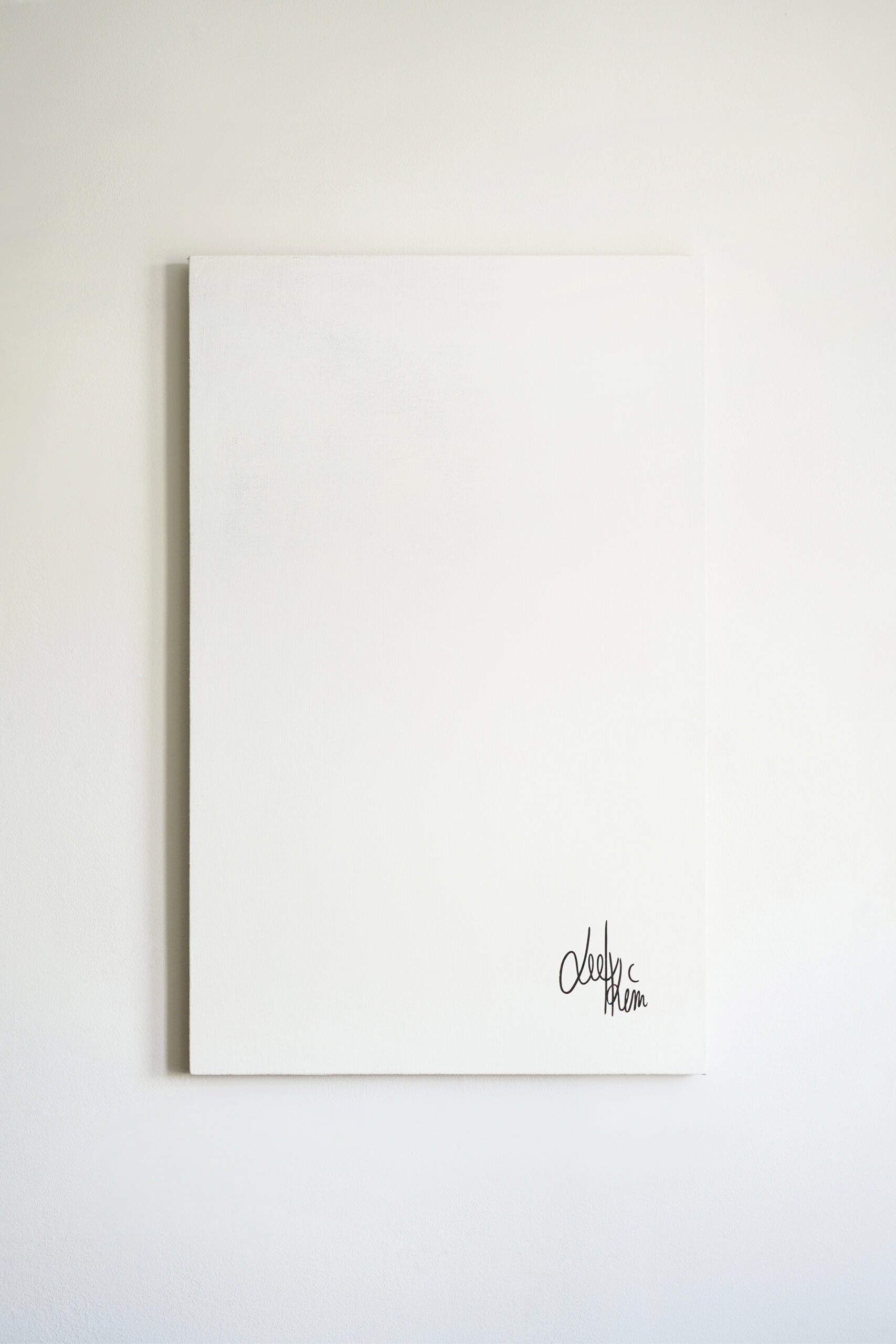
Take 1
Winter 2021/2022
Acrylic and blood on linen canvas mounted on wood
100 x 62 x 3 cm
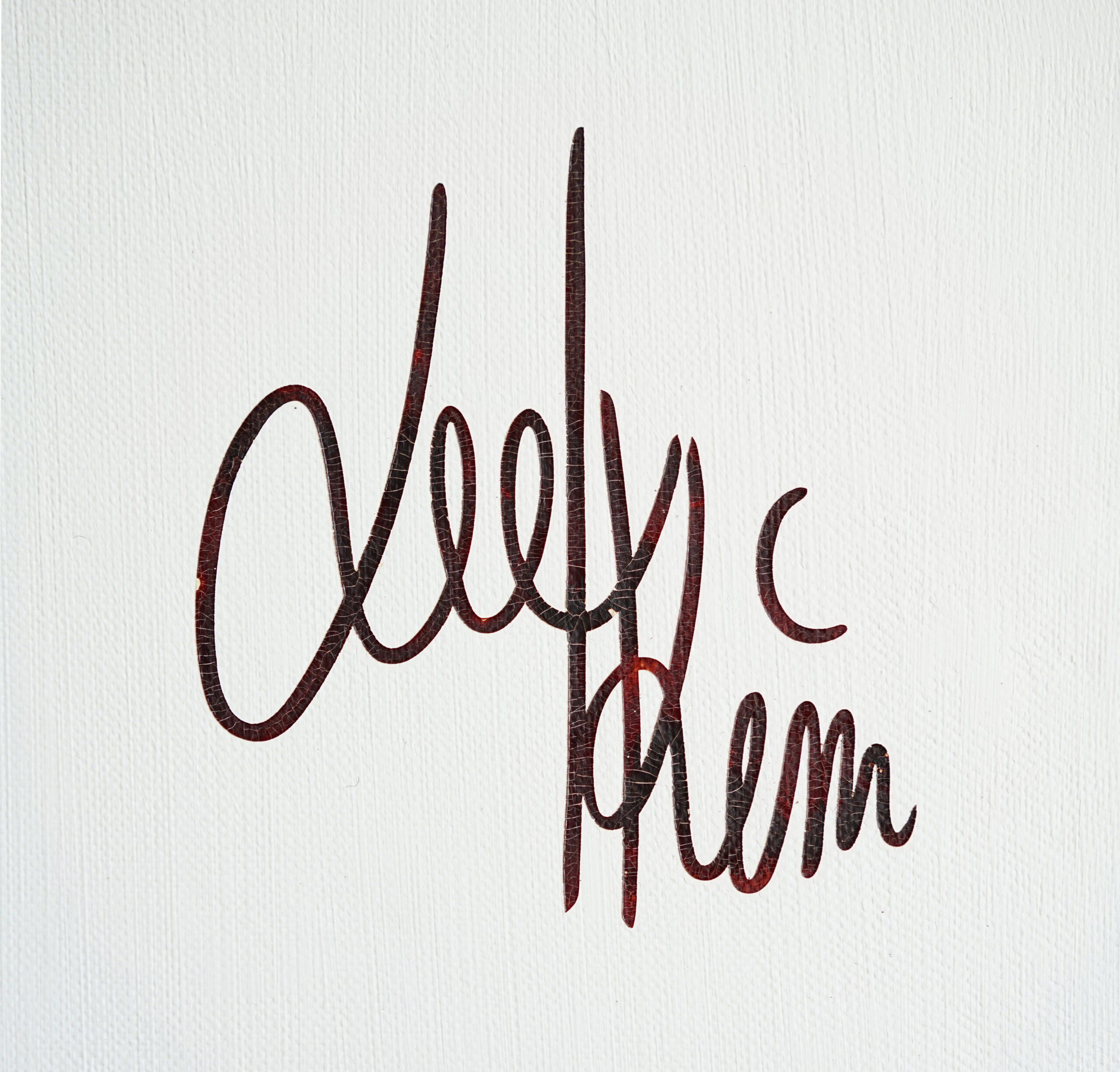
Extract 1
Winter 2021/2022
Acrylic and blood on linen canvas mounted on wood
Extended Text
A blank cheque is, first and foremost, a dangerous promise: a signature laid beneath an empty space, before the words themselves have arrived. The gesture comes before the content; assent precedes formulation; authority steps forward before fully knowing what it is binding itself to. To sign in blank is to postpone the meaning of what has nevertheless already been sealed. It is to consent to the unknown, to offer one’s mark to what has not yet come into being.
In a certain sense, every work of art passes through a comparable moment. It too appears, for an instant, as a surface still awaiting inscription — not empty of intention, but surrendered to what may one day be written upon it: outside it, within it, sometimes even against it. For although a work may indeed arise from its maker’s will, thought, and necessity, that origin is never enough to contain what it will become under the gaze of others. The artist deposits a direction there, not a closure; a force, not a verdict.
This is one of art’s singular conditions. Unlike verbal language, it possesses no stable code, no shared convention capable of guaranteeing a perfect correspondence between what is sent and what is received. Each artist fashions, through materials, forms, and deviations, a language that belongs to them alone. What follows is not simply a plurality of vocabularies, but a plurality of ways of reading. The work does not circulate within a sealed system of meanings: it offers itself to interpretations that shift — at times proximate, at times opposed, always incomplete.
And yet the visual work has a power that writing does not entirely share: it gives itself at once. It may be taken in in a single glance, grasped in the instant of looking. But such immediacy exhausts nothing; it only begins. For what is seen all at once is not thereby understood all at once. Once circumscribed, the work slowly yields itself to discernment. Within its very simultaneity, it opens another, quieter duration, in which perception deepens, shifts, contradicts itself, and turns back upon itself. Here, the visible is not the end of meaning, but its suspension.
It is in that interval that the work becomes a blank cheque. For an indeterminate span, it slips free of the sovereignty of the one who made it. Though it comes from its maker, it no longer fully belongs to them. It passes beneath other, more diffuse and uncertain authorities: the viewer’s memory, involuntary associations, affects, intimate narratives, projections, resistances. It is taken up again, renamed, displaced. Its first identity does not disappear, but it ceases to be singular. Barely born to itself, the work already begins to live elsewhere.
Thus, what was first signed by the artist becomes a surface of inscription for others. Meaning, once tied to an origin, is distributed, diffracted, recomposed according to as many readings as there are gazes to receive it. Nothing allows its destination to be fixed once and for all. Neither can the author govern all its drift, nor can the spectator claim possession of its key. Between the two, the work remains offered — blank, not in the sense of absence, but of availability. It becomes the place where several provisional truths may take form, overlap, cancel one another out, or begin anew.
The blank cheque here is therefore not the abdication of meaning, but the condition of its openness. What has been signed is not emptiness, but reserve. A work may never be more fully realised than in this relative loss of mastery, when, departing from the sole will of its maker, it consents to become the support for readings neither foreseen nor intended. Blank in its destination, it allows itself to be written a second time.
K.L.
Afterword
Once given over to view, a work no longer belongs entirely to the one who made it. It passes into other memories, other affects, other narratives. I know this. Yet such openness erases neither the impulse that brought it into being nor what it continues to carry of its origin. A work is not only what it becomes for others; it also remains the offspring of the one who conceived it.
The blank cheque presented here in painted form is, of course, symbolic. It takes on the appearance of one almost literally, to the point of seeming like a faithful enlargement. And yet what stands before us is no longer a true blank cheque. Its content, though apparently absent, has shifted into the very idea the work embodies. The visible void is not a pure void: it is already inhabited by the concept that grounds it. In that sense, the work is a false blank cheque — or rather, a blank cheque transposed into the realm of painting, where the absence of text is paradoxically filled with meaning.
The painting is empty — as a blank cheque must be. Or almost. One element alone could not withdraw from that emptiness: the signature. It is the minimal yet decisive condition of the work. It therefore seemed right to give it a density greater than that of an ordinary signature, as though this sign, already charged with authority, had to bear the weight of the whole work on its own.
Perhaps there is a form of resistance in this. Perhaps too a difficulty in consenting to complete dispossession. Perhaps, finally, a measure of narcissism — but I accept that a work, however open, is not thereby relinquished without remainder. Thus the signature, the only pictorial figure present on the canvas, is executed in my own blood. To the handwritten mark of identification is added a biological presence, irreducibly personal. The body comes to uphold the name.
This is not an attempt to close what the work opens, nor to take back with one hand what was offered with the other. It is, rather, a way of sustaining the tension that constitutes it: between abandonment and attestation, between openness and attachment, between what is given over and what remains. If the blank cheque calls for the freedom of others, it does not thereby sever itself from every origin. It remains signed.
K.L.