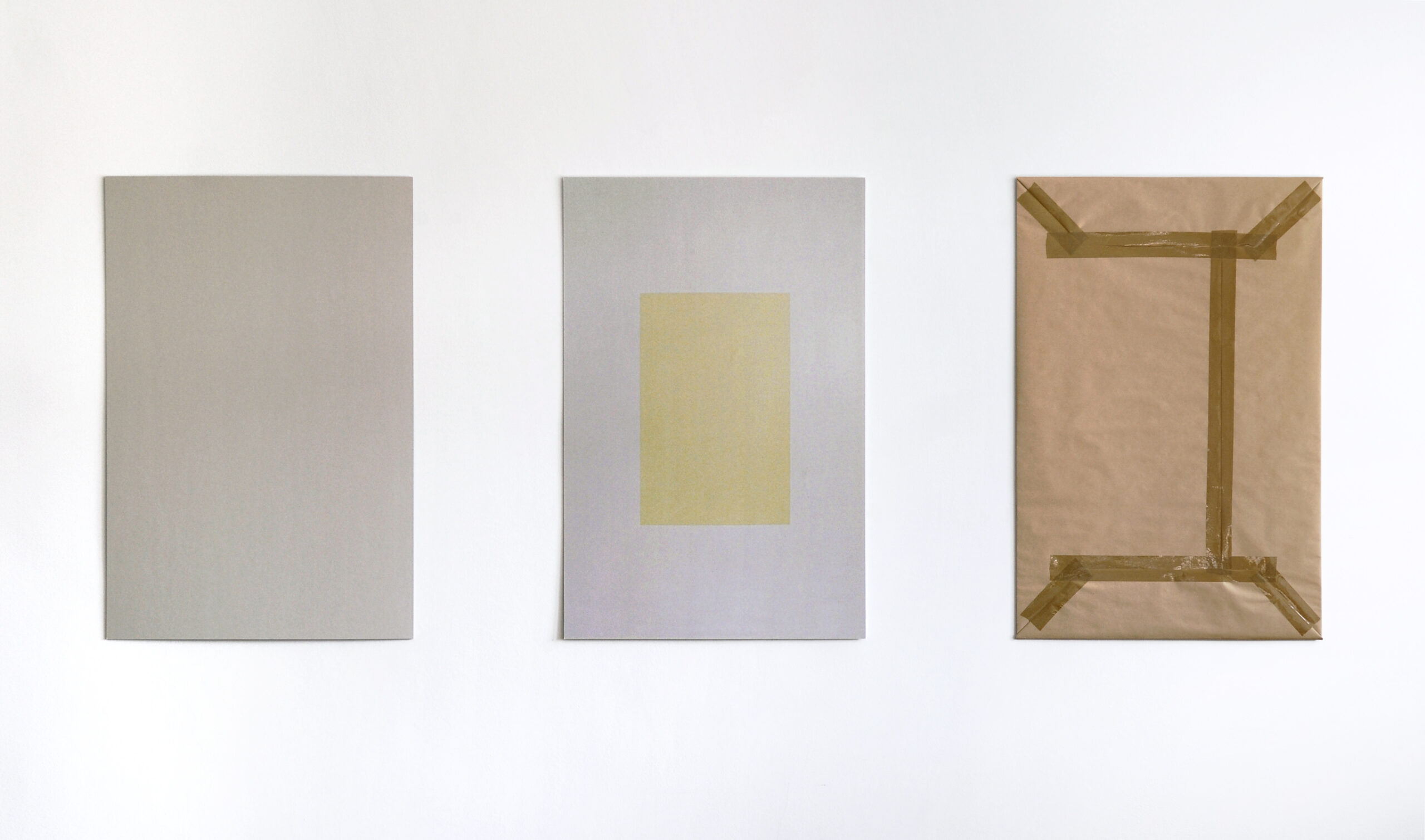
Take 1
Summer 2008
Double–ply grey cardboard, matte Fuji photographic paper mounted on PVC, 90 g/m² kraft paper, polypropylene ribbon
Photographic production: Christophe Urbain, Strasbourg, France
Overall dimensions: 90 × 240 × 0.4 cm
Individual dimensions: 90 × 60 × 0.4 cm
Photography: Jean-Philippe Senn, Strasbourg, France
The point of departure for Cardboard, U.V. & Conservation lies in a gesture almost naïve in its simplicity: a sheet of cardboard exposed to the sun. Under the action of ultraviolet light, the surface undergoes a slow metamorphosis: the original neutral grey deepens, warmed into a golden tone, almost ochre. The centre, surrendered to light, bears the trace of this gentle burning; the outer edge, left in shadow, preserves the memory of its first hue. Thus, within the rectangle, another rectangle appears — a solar imprint, the silent image of an invisible event.
Behind this elemental experiment lies a more complex question: how can one show what cannot be shown without endangering it? The sun acts here as both revealer and destroyer. What it brings to light, it consumes; what it illuminates, it alters. The work becomes the stage for a contradiction: its very visibility threatens its existence.
From this tension arises a shared dilemma between artist and conservator alike: how to exhibit without exhausting? how to reveal without erasing? must one, in order to preserve, refrain from showing? Three possible answers coexist: never to exhibit, never to unveil, or to exhibit veiled. This triptych of choices takes visible form here.
The first piece is a life-sized photograph of the original cardboard, marked by sunlight. The photographic reproduction fixes what light has already transformed; it lends permanence to the ephemeral, yet shifts the substance of the material into that of the image. What remains is no longer the flesh of cardboard, but its memory impressed upon another surface.
The second piece returns to the unadorned material: another sheet of cardboard, raw and untouched.
It draws the gaze back from representation to the concrete, recalling not a motif but a substance — not an image, but a latent potential. It is a return to the silence before light.
The final piece, the original itself, remains present yet unseen, hidden beneath brown kraft paper. Its absence is not a withdrawal but a mode of endurance. Its concealment becomes a form of fidelity — to itself, to its own fragility. The work survives only in shadow, in the economy of its disappearance. For there are things that can live only by retreating. The child of the moon owes its survival to an unbroken modesty.
K.L.
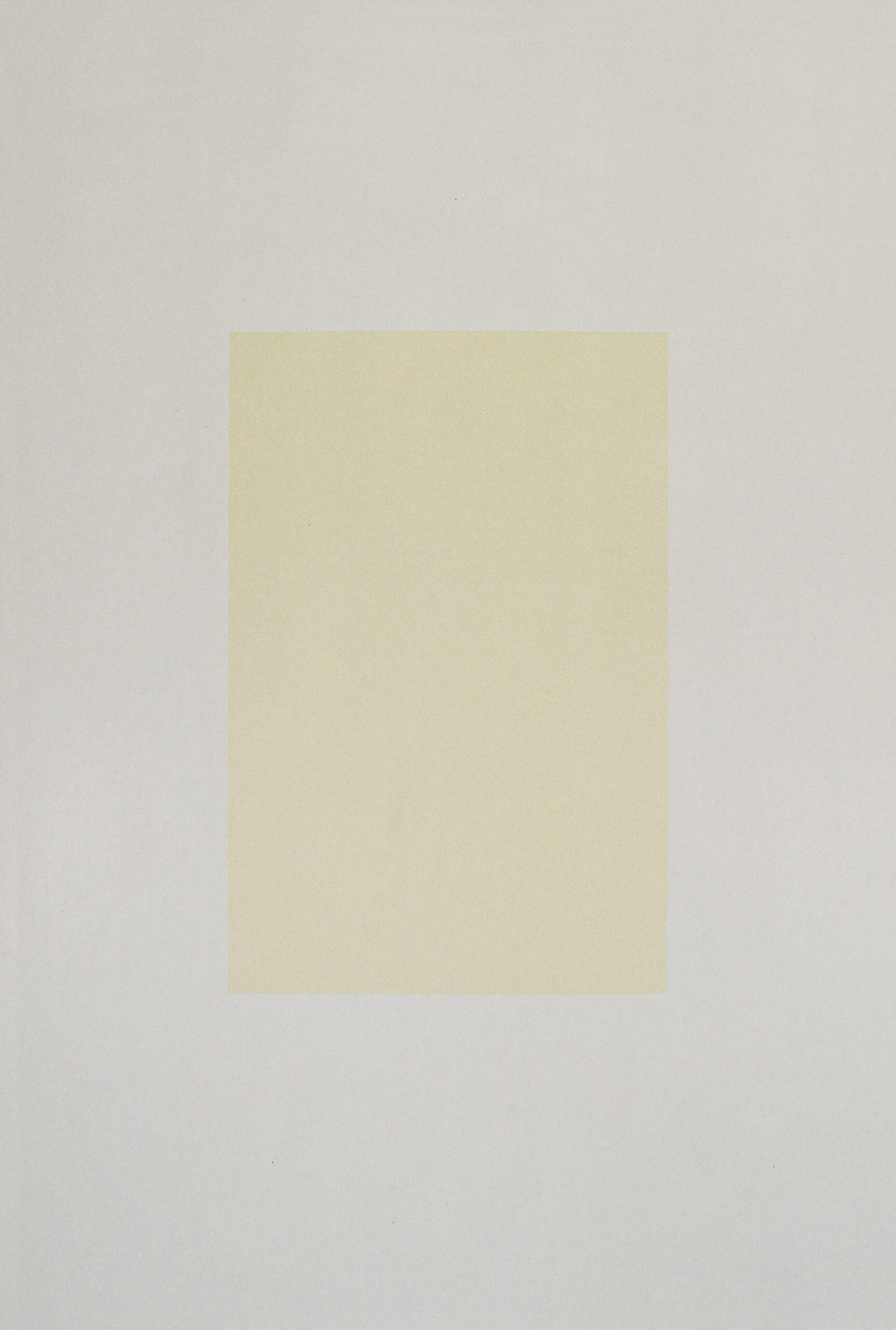
Original cardboard sheet exposed to sunlight — source image for Carton, UV & Conservation
Photograph by Christophe Urbain, Strasbourg, 2008