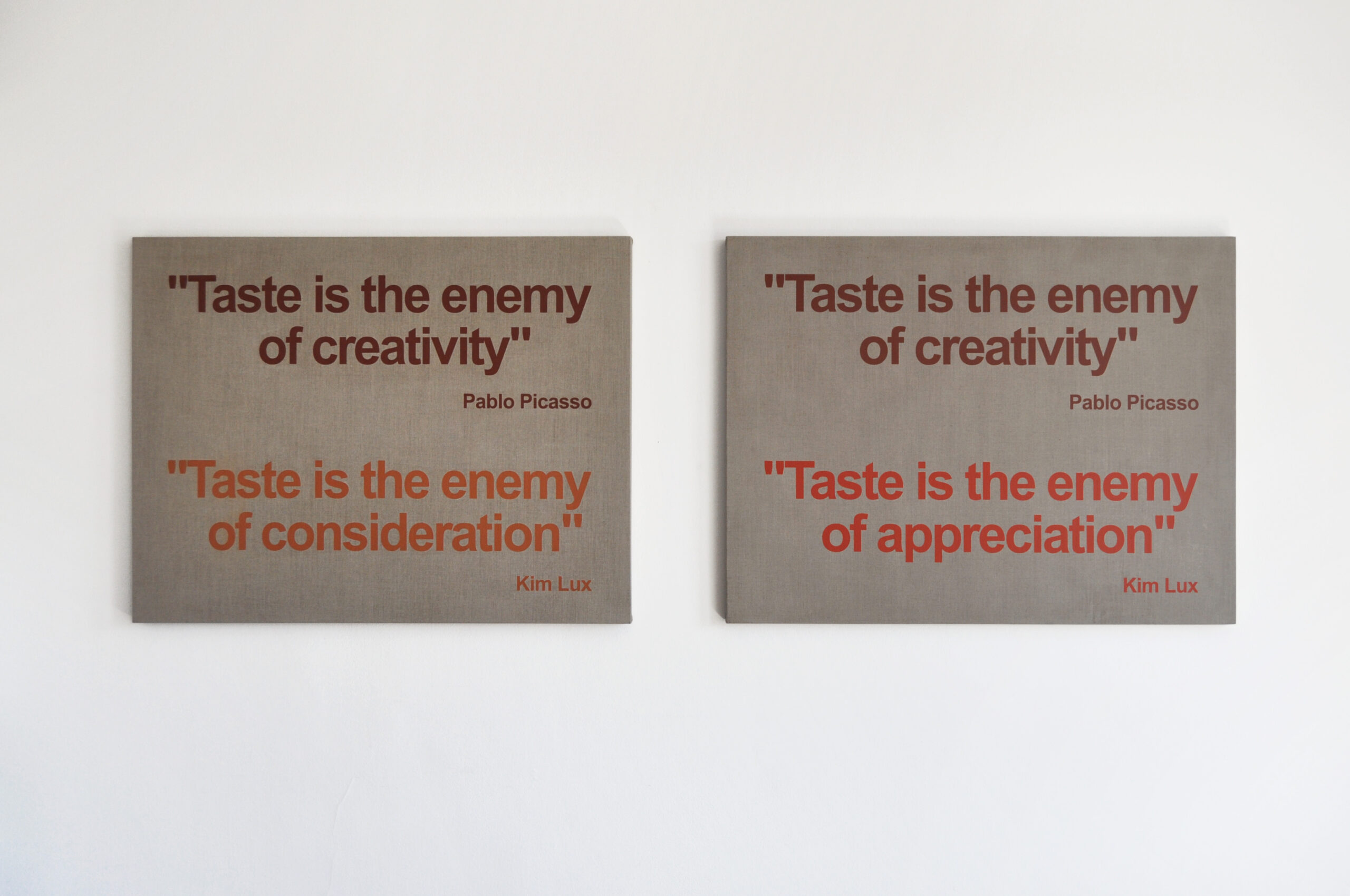
Take 1
Spring 2017
Acrylic on linen canvas mounted on wooden panel
2 × (75 × 100 × 3 cm)
In his early years, like so many artists, Picasso followed what he loved. It seems self-evident: why resist the subjects and means that give rise to beauty and pleasure? Yet over time, every artist learns that taste, while a source of guidance, is also a form of confinement. To refine one’s sensibility is to sharpen awareness of its boundaries—and to feel the quiet necessity of exceeding them.
Taste defines, but it also delimits. It offers a framework for perception, even as it risks becoming a cage. Can it be mastered? Perhaps only by transforming it. For taste is not immutable: it evolves, divides, and renews itself. The artist learns to appreciate what once eluded them—to find substance in what initially provoked indifference or resistance. From this encounter with the unfamiliar, imagination is enriched, and invention begins. Remaining within the comfort of one’s original taste is to risk repetition rather than renewal.
Picasso’s insight applies first to the artist, but equally to the spectator. For them too, taste can narrow the field of perception, blinding the eye to what does not immediately please. To consider, and later to appreciate, demands a subtle unlearning—a willingness to see otherwise.
Ultimately, creation and contemplation share the same gesture: the opening of the mind. To consider, and to appreciate, are creative acts in themselves—moments where receptivity becomes a form of making, and looking becomes an act of creation.
K.L.